The same safety checks apply to rhinoplasty in the UK or Turkey; only the registers differ. Before booking abroad, confirm the hospital's and facilitator's Ministry of Health authorisation, the surgeon's specialty and experience, a written plan read in advance, a realistic flight date and how follow-up works at home. Price should not decide.
Why a checklist matters
Rhinoplasty is one of the most technically demanding facial operations. The NHS notes it is usually done under general anaesthesia, takes around 1.5 to 3 hours, and that swelling can take months to settle [1]. Travelling adds extra steps: a flight, a stay away from home and follow-up across borders.
UK data show why preparation matters. An analysis of the British Association of Aesthetic Plastic Surgeons (BAAPS) complications database found that inadequate aftercare and premature air travel were among the recurring contributing factors in patients who needed NHS care after surgery abroad [6]. A 2026 review commissioned in the UK reached a similar conclusion: better information is needed about risks and follow-up for people travelling for surgery [7]. None of this means surgery abroad is unsafe by default — it means the checks below are worth doing.
UK and Turkey: the same checks, different registers
| What to check |
In the UK |
In Turkey |
| Facility |
Registered with the Care Quality Commission (CQC) in England [1] |
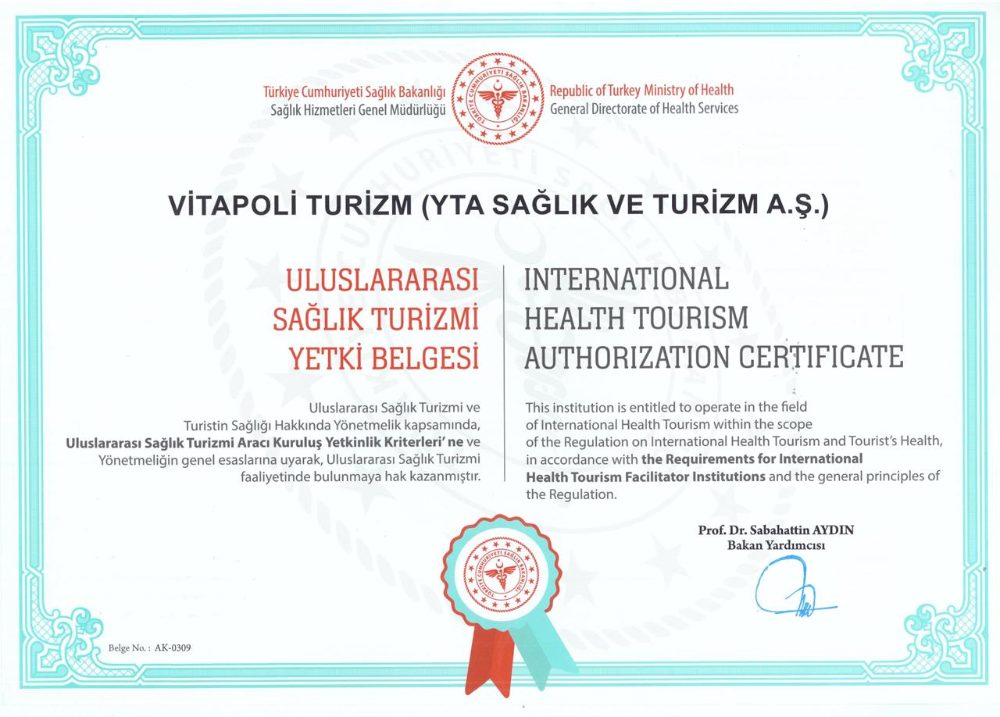
Licensed by the Ministry of Health; for international patients, an international health tourism authorisation certificate (Uluslararası Sağlık Turizmi Yetki Belgesi) [9] |
| Agency / facilitator |
Not usually involved |
If an intermediary arranges your care, it should also hold Ministry authorisation as a health tourism facilitator [9] |
| Surgeon |
GMC specialist register and licence to practise [1] |
Board-certified specialist (plastic surgery or ENT); BAAPS and TSPRAS suggest TSPRAS membership and at least five years in practice [4] |
| Consultation |
Two consultations with a cooling-off period are recommended [2] |
Same principle: see the surgeon in advance; one consultation in person [2, 5] |
| Consent |
Written, after discussion |
Comprehensive informed consent before travelling [4] |
| Aftercare |
Local follow-up |
A written aftercare plan and a named contact if problems arise [4] |
The checklist
1. Licences and authorisation
- Ask for the name of the hospital and confirm it is licensed by the Turkish Ministry of Health and authorised for international patients [9].
- If a facilitator is involved, ask for its authorisation details. AYT Clinic is a licensed medical tourism facilitator (YTA Sağlık ve Turizm A.Ş.), not a clinic.
- BAAPS and the Turkish Society of Plastic Reconstructive and Aesthetic Surgeons (TSPRAS) recommend surgery in a fully recognised hospital [4].
2. Surgeon information
- Know your surgeon's name before you travel, their specialty and how long they have practised [4].
- Ask how many rhinoplasty operations they perform and how revisions are handled [1].
- Make sure you can speak with the surgeon directly, not only with sales staff [2].
3. A written plan
- The plan should describe the goals agreed with the surgeon, open or closed approach if known, type of anaesthesia, what is included, and the follow-up schedule.
- You should receive the consent form before travelling and have time to read it [4].
- Two consultations before surgery, with time in between to reflect, are recommended by both the NHS and BAAPS [2, 5].
4. Flight timing
- The NHS advises against flying for 7–10 days after facial procedures because air travel after major surgery raises the risk of blood clots [2].
- BAAPS guidance for operations under general anaesthesia of up to three hours suggests arriving at least 72 hours before surgery and staying one to two weeks afterwards [5].
- On the flight home, BAAPS suggests an aisle seat, good hydration, moving during the flight and compression stockings [5]. See flying after surgery and deep vein thrombosis in our glossary.
- Your own travel dates are confirmed in your personal plan, based on your surgeon's advice.
5. Follow-up after you return
- Ask how the surgeon will review your progress remotely and at what intervals.
- Ask who to contact out of hours, and what happens if you need an examination or a revision [2, 4].
- Check whether your travel insurance covers complications from planned surgery; many standard policies do not [2].
- Keep copies of your operation notes for your GP.
Warning signs to take seriously
- You are offered surgery as part of a holiday package, or asked to pay before you have spoken with the surgeon [2].
- You only ever speak with sales staff, never with the doctor who will operate [2].
- You do not receive a consent form before travelling — BAAPS and TSPRAS describe this as a warning sign [4].
- Nobody can tell you the surgeon's name, specialty or the hospital in writing [4].
- You are encouraged to fly home within a few days of surgery, or to go sightseeing and swimming straight afterwards [2].
- There is no clear answer about what happens if a complication appears after you are home [2].
Who rhinoplasty may suit
Rhinoplasty may be considered if you are unhappy with the shape or size of your nose, have breathing problems linked to the internal structure (which may need a combined functional operation), are in good general health, and have realistic expectations. Your nose should have finished growing. Smoking increases healing problems, so most surgeons ask you to stop beforehand.
The procedure in brief
- Consultation: photos, medical history and a discussion of goals; then an in-person examination before surgery.
- Anaesthesia: usually general anaesthesia [1].
- Surgery: open (a small cut between the nostrils) or closed (cuts inside the nostrils). Bone and cartilage are reshaped; grafts are sometimes needed [1].
- Dressing: a splint and tape on the nose for about a week [1].
Recovery timeline
Based on NHS guidance [1]:
- Days 1–7: blocked nose, light bleeding, swelling and bruising around the eyes; the splint stays on.
- Around day 7: splint and non-dissolvable stitches are usually removed.
- Up to 2 weeks: time off work.
- Around 3 weeks: most visible bruising and swelling have faded.
- 4–6 weeks: strenuous exercise can usually restart; avoid contact sports for this period.
- Months: remaining swelling, especially at the tip, settles gradually; full results can take several months.
More detail is on our rhinoplasty aftercare page. Your personal recovery timeline is set out in your plan.
Risks (general)
The NHS lists nose-specific risks including breathing difficulty, damage to the wall between the nostrils, a changed sense of smell and nosebleeds, alongside general risks of surgery such as bleeding, blood clots, infection and reaction to anaesthesia [1]. No surgeon can promise a specific result, and some patients choose revision surgery. Reviews of complications after surgery abroad most often report infection and wound problems, which is why aftercare planning matters [8].
How the process is planned in Antalya (general)
- You send photos of your nose from several angles and your medical history.
- The surgical team reviews them; a written plan lists the hospital, the surgeon's details, the anaesthesia and the follow-up schedule.
- You receive the consent form before you travel.
- Arrival, surgery and travel dates follow your surgeon's advice and are stated in your personal plan.
- After you return, follow-up continues remotely at agreed intervals.
If something on this checklist is missing from your plan, ask us before you book.
Frequently asked questions
Is rhinoplasty in Turkey safe?
Safety depends on the hospital, surgeon, planning and aftercare rather than on the country. Use the checklist above, and ask for anything missing in writing.
How do I check a surgeon in Turkey?
Ask for the surgeon's full name, specialty and board certification. BAAPS and TSPRAS suggest checking TSPRAS membership and at least five years in practice [4].
When can I fly home after rhinoplasty?
The NHS advises waiting 7–10 days after facial surgery before flying [2]. Your surgeon will confirm your date.
Do I need two consultations?
The NHS and BAAPS recommend two consultations before surgery, with time to reflect in between [2, 5]. At least one should be in person [5].
What if I need follow-up in the UK?
Bring your operation notes, and agree in advance how your surgeon will review you remotely. Tell your GP about your surgery.
Next step
Read more about rhinoplasty in Antalya, then send us your photos and questions. We will reply with a written outline you can check against this list.
Related reading: Rhinoplasty Recovery Week by Week: Swelling, Splint and Final Results · Open vs Closed Rhinoplasty: Which Technique Is Right for You? · Rhinoplasty cost in Turkey: what's included
Sources
Tüm URL'ler 13.11.2026'da kontrol edildi (HTTP 200 veya PubMed E-utilities kaydı).
- NHS – Nose reshaping (rhinoplasty) (last reviewed 22 Sep 2023). https://www.nhs.uk/tests-and-treatments/cosmetic-procedures/cosmetic-surgery/nose-reshaping-rhinoplasty/
- NHS – Cosmetic surgery abroad (last reviewed 14 Dec 2022). https://www.nhs.uk/tests-and-treatments/cosmetic-procedures/advice/cosmetic-surgery-abroad/
- NHS – Treatment abroad checklist. https://www.nhs.uk/using-the-nhs/healthcare-abroad/going-abroad-for-treatment/treatment-abroad-checklist/
- BAAPS & TSPRAS – Joint statement for UK patients considering surgery in Türkiye (23 Jun 2023). https://baaps.org.uk/about/news/1877/joint_statement_from_the_baaps_the_british_association_of_aesthetic_plastic_surgeons_and_tspras_the_turkish_society_of_plastic_reconstructive_and_aesthetic_surgeons/
- BAAPS – Cosmetic tourism guidelines (September 2023, v1). https://baaps.org.uk/_userfiles/pages/files/baaps_cosmetic_tourism_guidelines_sept_23.pdf
- Goodarzi MR, Nugent NF, Pacifico MD, Tyler M, Wokes JET. Beauty abroad, burden at home: complications and National Health Service impact of cosmetic tourism – insights from the BAAPS national database. Aesthet Surg J 2026;46:1177–1183. doi:10.1093/asj/sjag056. https://pubmed.ncbi.nlm.nih.gov/41806385/
- England C, Bromham N, Needham-Taylor A, et al. Complications and costs to the UK National Health Service due to outward medical tourism for elective surgery: a rapid review. BMJ Open 2026;16:e109050. doi:10.1136/bmjopen-2025-109050 (PMC12815047). https://pubmed.ncbi.nlm.nih.gov/41529913/
- Alkaelani MT, Koussayer B, Blount T, et al. Complications of medical tourism in aesthetic surgery: a systematic review. Ann Plast Surg 2023;91:668–673. doi:10.1097/SAP.0000000000003683. https://pubmed.ncbi.nlm.nih.gov/37962261/
- T.C. Resmî Gazete – Uluslararası Sağlık Turizmi ve Turistin Sağlığı Hakkında Yönetmelik (13 Tem 2017, sayı 30123). https://www.resmigazete.gov.tr/eskiler/2017/07/20170713-3.htm
- Europäisches Verbraucherzentrum Deutschland – Schönheits-OPs im Ausland: Checkliste. https://www.evz.de/reisen-verkehr/gesundheit/kosmetische-behandlungen/checkliste.html
Medically Reviewed
Medically reviewed by Dr. Mehmet Ali Korkmaz, Plastic Surgeon.
Last updated: 14.11.2026
 Book Online