 Book Online
Share your details and our team will contact you shortly.
A dental implant procedure usually has four stages: assessment and planning, placing the implant in the jawbone under local anaesthetic, a healing period of roughly two to six months while bone bonds to the implant, then fitting the abutment and crown. The surgery itself is short; most of the timeline is healing time. See our dental implants in Antalya page for how treatment is planned.
A dental implant is a small screw, usually titanium, placed in the jawbone to act as an artificial tooth root. Once it has healed, it can hold a single crown, a bridge or a denture [1, 2]. The finished restoration has three parts:
These parts are made and fitted at different stages, which is why implant treatment takes months rather than days.
| Stage | What happens | Typical time (varies by person) |
|---|---|---|
| 1. Assessment | Examination, X-rays or a 3D scan, medical history, treatment plan | One or more appointments |
| 2. Preparation (if needed) | Extraction, gum treatment or bone grafting | Can add several months [3, 5] |
| 3. Implant placement | Implant placed in the jawbone under local anaesthetic | Usually one appointment |
| 4. Healing (osseointegration) | Bone grows onto the implant surface | Around 2–6 months; often longer in the upper jaw or after grafting [1, 3, 5] |
| 5. Uncovering and abutment | Minor procedure in two-stage treatment; abutment attached | Short appointment |
| 6. Crown, bridge or denture | Scan or impression, laboratory work, fitting and bite check | Usually two or more visits over several days |
| 7. Maintenance | Cleaning at home, regular check-ups | Ongoing [1, 3] |
Everything starts with a consultation. The dentist checks your teeth and gums, looks at the bone with X-rays or a 3D scan, and asks about your general health and medicines. The American Dental Association notes that overall health matters more than age, and that some long-term conditions, such as poorly controlled diabetes, can affect healing [2].
Smoking is discussed at this stage. A systematic review of 107 studies found an implant failure rate of 6.35% in smokers compared with 3.18% in non-smokers [7]. An NHS hospital leaflet advises smokers to stop well before treatment [3].
If you are planning treatment abroad, recent photos and an X-ray from home help the dental team give a first opinion. The plan is confirmed only after an in-person examination.
Not everyone needs this step. It may include:
The implant is usually placed under local anaesthetic as an outpatient procedure [5]. The dentist opens the gum, prepares a precise channel in the bone and places the implant. The gum is then closed with stitches, or a small healing cap is left visible.
Most people describe pressure and vibration rather than sharp pain during the procedure. Discomfort and swelling afterwards are common for a few days [3]. Our separate guide on implant pain and recovery covers the first two weeks in detail.
This is the longest stage. Bone gradually grows onto the implant surface, a process called osseointegration [2]. The Oral Health Foundation describes a healing period of around four months before the final tooth is attached [1]; an NHS hospital leaflet gives three to six months, and longer after a bone graft [3]. Barmer notes that healing often takes longer in the upper jaw [5].
During healing you may wear a temporary tooth or denture so there is no visible gap. Avoid chewing hard food on the implant site and follow your cleaning instructions closely.
In two-stage treatment, the implant is uncovered with a minor procedure once it has healed, and the abutment is attached [3]. In one-stage treatment, the healing cap is already visible, so this step is simpler.
The dental team takes a digital scan or impression. The laboratory makes the crown, bridge or denture to match the shape and shade of your teeth [2, 4]. At the fitting appointment, the fit and bite are checked and small adjustments are made. A crown on an implant may be screwed or cemented to the abutment, depending on the plan.
Sometimes. The Oral Health Foundation and the ADA both note that, in some cases, a replacement tooth can be fitted on the same day as the implant [1, 2]. This depends on bone quality and on how stable the implant is when it is placed. Even then, the first tooth is usually temporary, and the final crown is fitted after healing.
Without bone grafting, the healing stage alone usually takes around two to six months, plus time for the crown [1, 3, 5]. With grafting or a sinus lift, it can take considerably longer [3, 5]. In NHS hospital restorative care, where cases are often complex, total treatment usually takes at least a year [3].
For patients travelling from the UK, a common pattern is two trips: the first for assessment and implant placement, the second after healing for the abutment and crown. Your exact schedule, and how many visits you need, is set out in your personal plan.
Implant surgery is a routine procedure, but it is still surgery. Possible problems include infection, delayed healing, numbness from nerve irritation (rare and usually temporary), an implant that does not bond with the bone, and, years later, gum and bone inflammation around the implant (peri-implantitis) if cleaning is poor [1, 3, 6]. Your dental team should explain the risks, benefits and alternatives, such as a bridge or denture, before you agree to treatment.
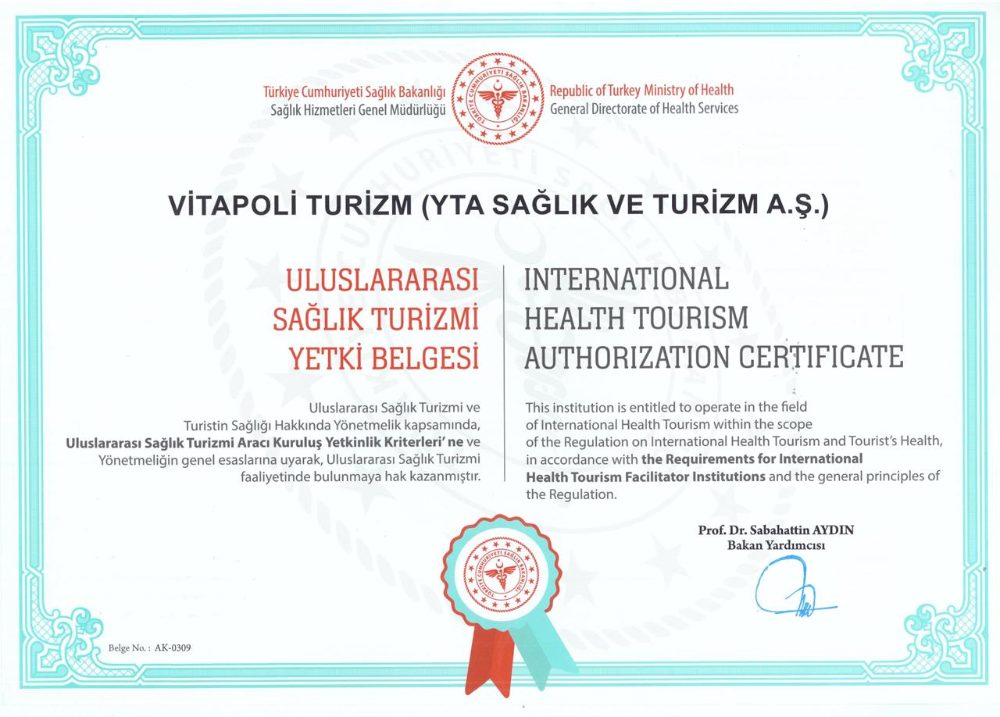
AYT Clinic is a licensed health tourism facilitator. Treatment is carried out by the dentist and clinic named in your plan; AYT coordinates the process. In practice:
AYT's dental implant prices start from £310 per implant. This covers the implant screw only; the abutment and crown are priced separately and shown in your personal plan.
Before booking, the NHS checklist for treatment abroad is worth reading: check qualifications, ask for a written plan and costs, and agree what happens if you need follow-up care after you return [8].
Usually at least three: assessment, implant placement and crown fitting. Bone grafting, a temporary tooth or a two-stage approach can add visits.
Usually not. Most implants are placed under local anaesthetic [5]. Sedation may be discussed for longer procedures or anxious patients.
For a single implant, the surgical part usually fits into one appointment. Several implants, grafts or a sinus lift take longer.
Many people return to desk work soon afterwards. Swelling and discomfort are usually greatest in the first few days, so plan a lighter schedule for that period [3].
Ask your dental team. Most short flights are possible after a simple implant, but advice can differ after a sinus lift or bone graft.
The bone needs time to bond to the implant. Loading it too early can disturb healing [1, 3].
Read more on our dental implants page and send us photos and any recent X-ray. The dental team will tell you which stages are likely to apply to you, and we will set out the visits in a written plan.
Tüm URL'ler 13.11.2026'da kontrol edildi (HTTP 200, PubMed E-utilities kaydı veya web araması ile).
Dentist
Last updated: 14.11.2026
AYT Clinic (YTA Sağlık ve Turizm A.Ş.) is a licensed health tourism intermediary (licence no. AK-0309) that coordinates treatments in Antalya.
Make an Appointment
Talatpaşa Boulevard No: 113-9, Hacettepe Mahallesi, Altındağ / Ankara, Türkiye
Çalkaya Falezleri Cad. No: 2 Daire: 8, Altıntaş / Aksu / Antalya, Türkiye
Send Email: [email protected]
Call Us: +90 850 888 6898